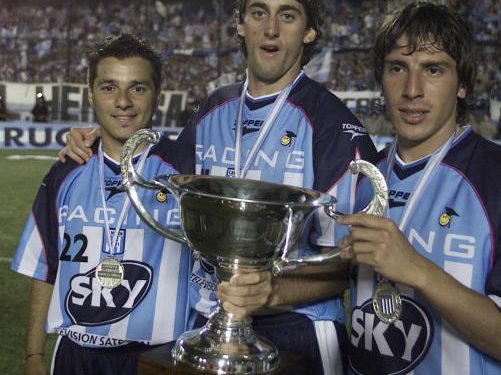
As President Fernando de La Rua escaped the presidential office in a helicopter among scenes of anarchy below, Racing Club fans could still scarcely believe that the club had won it’s first trophy in 35 years. For many that know Racing or the tale of the 2001 success, one could not be more fitting of a club. A club that has reveled in despair for so long should celebrate their first title in 35 years while the country was on the brink of anarchy with no Government or police force and a complete collapse of the economic system.
Everything about the championship seemed very ‘Racing’, the fact that Torneo Apertura that should have lasted just over four months that ended up lasting seven. The fact that they almost squandered the title despite having it seemingly wrapped up weeks earlier. The fact that they won it while technically bankrupt and having ‘ceased to exist’ just two years earlier.
There are various points at which tellers of this tale prefer to start, most give priority to the curse of the 7 dead cats which fans of Independiente are said to have placed behind the goal in the Racing Stadium. During this time Racing went from World champions to title-less for 35 years, that was until the pitch was finally dug up in the year 2000 and it is said the skeleton of the 7th cat was found. A fascinating and well told anecdote, however in this article more priority will be given to the events surrounding the club’s turbulent bankruptcy period in which the championship victory was sandwiched in between.
A grey day in Avellaneda
On the 4th March 1999 it was declared in a now infamous statement by Lilliana Ripol that ‘Racing Club Asociacíon Civil ha dejado de existir (Racing club has stopped existing)’. How Racing reached this point was an impressive ability to overachieve in an all too familiar trait in Argentine football of over inflating staff numbers, poor planning and corruption.
While also a factor in the club’s salvation, the crux of the bankruptcy lay in the status of football Club’s within the country. Typically Football clubs are associations that belong to their members; the structure in reality belongs in its own dimension of organisation somewhere between public and private yet often with Government support in various forms. The disadvantage of this status is that funds are often appropriated by the few who occupy positions of power due to lacking transparency, unlike a typical Public Limited Company other stakeholders (fans) have no financial incentive to see the organisation succeed apart from that it should lead to better results on the field. The management at Racing took this role of little accountability to the brink over the years leading up to 1998/1999 when they had completely neglected to pay numerous accounts while being frivolous with the clubs bankroll. Inevitably this came to a head in 1998 when the bankruptcy claim was placed by a creditor to the Argentine courts who proceeded to investigate the claim.
Bankruptcy
Racing quiebra
After stringent auditing it was revealed that the club owed the sum of $66.5million, a figure which of course by today’s standards seems fairly manageable. Though this was 1998 Argentina and the fees recouped for players were much lower while looming crisis meant less public funds and bank loans were at the disposal of the club.
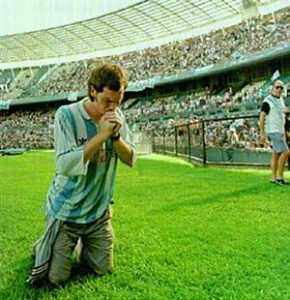
Despite the decree that the club no longer existed following an inability to pay its debts, the idea that the club would disappear was inconceivable. The fans mobilised quickly, forming protests in all possible ways, they crammed into the stadium despite their being no game and continued to cut off major transport links in Buenos Aires until the agreement was reached to spare the club more time on repayments. One of the iconic images from this period is of a fan walking across the turf on his knees appearing completely unattached from his body and unable to comprehend what is happening to his club. The image became so iconic that it would be imitated 2 years later as Racing players walked across the turf on their knees but this time with tears of joy as they carried the Campeonato along with them.
After a year of uncertainty regarding the clubs capability to raise the required funds to pay the debts and prevent looming insolvency, The Blanquiceleste organisation lead by Fernando Martin and Fernando de Tomaso were approved to become the new owners in a court hearing in La Plata. The ownership was subject to an immediate $15million payment of some of the debts while assuring that the rest would be paid according to a stringent timetable. The experiment with private ownership could hardly have got off to a better start as Racing won the championship in December the following year coming just 2 years after being declared out of existence.
Privatised Crisis
The see-saw between public and private ownership in Argentina is often said to work in 10 year cycles and by 2008 the private experiment of football appeared to be already veering off course. Reports had shown that Blanquiceleste had been paying debts using the club’s money, thus the transfers of Diego Milito and Lisando López amongst others had merely serviced the debts which fans had thought would be paid by Blanquicelste as part of the deal in return for ownership of the club.
In addition, by this point in 2005 little investment had been made into the club’s decaying infrastructure with the exception of a refurbishment of the youth residence while the debts returned which Balnquiceleste had supposedly resolved. Numerous players, members of staff and creditors had made public that their management was not complying with court guidelines in the repayment of unpaid cheques and interests on debts owed by the club.
By 2007 the campaign against Blanquiceleste had erupted publicly and the Man leading it was none other than Reinaldo Merlo, the manager that had ended Racing’s 35 year wait for a title six years earlier. The manager that originated Diego Simeone’s game-by-game catchphrase had returned to Racing but was later dismissed by the Blanquiceleste management for claims made against them. When released Merlo filed for the bankruptcy of Blanquiceleste for unpaid wages amounting to two and a half million pesos ($800,000est) to him and half a million pesos ($125,000est) to his assistant. Racing had also defaulted on payments owed to Cerro Porteno for the transfer of Mingo Salcedo and later to a Paraguayan agent for the transfers of Marcos Cáceres and Érwin Arválos.
Under growing pressure from Racing fans who by this time had mobilised in numbers, Judges of the high court returned ownership to the members and the declaration was made that ‘Blanquiceleste ha dejado de existir’ in an ironic statement parodying that which was made about Racing Club Asociacíon Civil 9 years earlier and thus ending Argentine football’s brief trial with private ownership.
If every club represents a trait of the Country as the cliché goes, River the lavish, educated club from wealthy area, Boca the club of immigrants that went to achieve great success in adopted lands, then Racing undoubtedly represent Argentina’s seemingly perpetual suffering despite such great promise. The tale of a club that looked set for years of domination in the 1950’s and 60’s would then go on to win two trophies in the next 50 years while facing relegation and economic ruin along the way draws similarities to the country’s demise from its economic promise of the early 20th century to the cyclical crisis it has faced ever since.