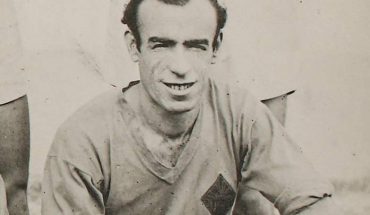
in the early 1930’s Saturnino Navazo was a promising Spanish football player who could never have envisaged his Republicam beliefs would take him from stardom to Nazi prison camp. Inside the camp football saved his life, and out of his privileged position he helped his fellow prisoners and adopted a nine year old Jewish boy.
The football career of Saturnino Navazo
Saturnino Navazo Tapias was born 6 February 1914 in Hinojar del Rey in the province of Burgos. When he was seven years old his family moved to Madrid, where his father worked as a baker. The family lived in the borough Cuatro Caminos, on whose dusty streets the football crazy boy chased a ball from dawn til dusk. After initially playing in a number of neighborhood clubs at youth level he went on to represent C.D. Nacional de Madrid, in those days third biggest club in Madrid, behind Real and Atlético. With Nacional, that dissolved in 1939, the midfielder acheived promotion to the 2nd division and had a growing popular fan base. Furthermore in 1934 they won the Copa Castilla thanks to a 4:3 victory in the final over Atlético Madrid; a trophy that at the time was one of great prestige. Navazo caught attention through goals and was close to be signed from 1stt division club Betis Sevilla. On the eve of his big move his life would take a tragic twist owing to the outbreak of the Spanish Civil War in July 1936.
The way to Mauthausen
With the beginning of the Civil War Navazo hung up his football boots and joined the Republican Army in the fight against the Rebel Faction of Franco. He was assigned the 20th army company, and during the war he fought as bolt action rifle shooter in Madrid, Valencia, and Barcelona. It can be determined from these aforementioned cities that the supporters of the Republic had been driven on and on northwards and eventually having to escape over the Pyrenees to France. In France, there were refugee camps for the supporters of the Republic, where they were taken care of and where they worked simultaneously for the French Army. They had escaped the war in their own country, but with the outbreak of World War II and the victory of Nazi Germany over France, they got caught up by with the past and the majority of the Spanish Republican were captured or killed. Franco told the German in no uncertain terms that the death penalty should be the concequence for those Republican defectors who were unfortunate enough to not be killed in battle. The Spaniards, including Navazo, were brought to Fallingbostel, before being deported in January 1941 to the Austrian concentration camp Mauthausen. Near the KZ were several quarries, in which the prisoners had to work under inhumane conditions. It was a category three camp – Extermination through labour – in which had been imprisoned until the end of the war 197.464 prisoners, of whom about 100.000 were killed, respectively died as a consequence of the work. Among them around 8.000 Spaniards, of whom survived about 2.000.

Wikipedia /Cpl Donald R. Ornitz, US Army / Day of the liberation. Banner: “LOS ESPAÑOLES ANTIFASCISTAS SALUDAN A LAS FUERZAS LIBERADO-RAS”
“Hay que hacerlo para creerlo” – “You have to do it, to believe it is possible”
As it can be seen from the numbers, it was a place of inhumanity in all aspects: Organized slave work was designed to kill the prisoners sooner or later, additionally supported by insufficient food supply and sadistic guards. Six days per week the line up was at 4:45 in the morning. Those who had died during the night were brought out from the barracks, and they worked until 7 pm, interrupted only by a ten-minute soup break. Among other things the prisoners had to carry 50 kilograms (110 lb) heavy granite blocks up the so called Todesstiege (Stairs of Death), with 186 stairs and 31 m of height difference. Those who dropped a granite block and couldn’t pick it up again were executed or pushed down the Fallschirmspringerwand (The Parachutists Wall). On Sundays it was only a half day and in the afternoons one washed himself, patched his clothes, and to entertain the guard-force there were football matches and box fights.
Football in the camp
From then on Saturnino Navazo was just prisoner 5656, but football continued to be his calling in life. He had sewn a ball out of rags, which he ran after, to warm up. When the German guards saw him, they asked him if he liked football, and if he could line up a Spanish team, a request with which he complied. what followed were both matches between prisoner teams of the respective countries and games between mixed prisoner teams against the SS-team. Navazo the ancient professional player stood out, and led the Spanish team. For more than four years they won almost every match against their Russian, Polish and Serbian opponents, and one could hear “Viva España” and “Olé” shouts on the roll call-ground. His style of play and his finesses even made the Germans applaud, and apparently also impressing the SS-commandant. Anyhow he was moved from the dead bringing quarry to the kitchen to peel potatoes, so that he could organise football tournaments in order to shine during the matches. Furthermore, he was declared head of a Spanish barrack with 200 prisoners. Thanks to his kitchen job he had a “relatively” good life, and he could smuggle out potato peels, and could give them to his compatriots.

Personal album of Siegfried Meir / Navazo 1st man standing on the right.
The games were something surreal in the camp, because they pretended normality at a place where there was none. This normality referring to the fact that for 90 minutes gone were the prison uniforms and numbers while returned were the names to which the man had been given at birth. The matches against the guards were played with great enthusiasm and intensity although the players had to maintain an element of reserve owing to the fact that if the guards disliked any action, the player was not to be seen again on the pitch. The Sunday matches presented the only distraction and one Spanish fellow inmate of Navazo said: “To watch a football match on Sundays, was like being in a different life”. And it was special moves and plays of the Spanish team that “played a huge role for the moral of everybody”, wrote Luis Garcia Manzano in his narrative La Rondalla de Mauthausen.
Siegfried Meir alias Luis Navazo
A few months before the liberation of the concentration camp Navazos life twisted once again with introduction of a nine-year-old German Jew, Siegfried Meir in to the camp. The boy had been deported from Auschwitz to Mauthausen, due to the fast approaching Red Army. The boy from Frankfurt, who had lost both of his parents in Auschwitz, refused vehemently to have his long flowing hair upon his arrival. Thereupon the camp commandant decided that Navazo was going to be responsible for him. What exactly made the commander assign the German kid to the Spaniard is unknown as verbal interaction was impossible due to the language barier. During the three months which they spent together they developed a special bond with Siegfried following his foreign tutor at every turn, earning the nickname “perrito” (small dog). In such a brief time they became inseparable, and the boy helped Navazo peeling potatoes, and massaged his legs before playing football.

Personal album of Siegfried Meir / “Father and son”
After the liberation through the Allies originally the Red Cross would have taken care of the orphan, but Siegfried Meir wanted to stay with Navazo, and asked him to take him with himself. The friends of Navazo advised against, but after a short time of reflection he took him, under the condition, that he had to pose himself as his real son. Since the age difference between them was about 20 years, this was credible. From then on Siegfried Meirs name was Luis Navazo and together along with other Spanish Republicans they moved to Revel, in the vicinity of Toulouse, as Franco’s regime continued to rule. Navazo started to play football again at Union Sportive Revenoise, with whom he won three consecutive regional championships. Due to a disagreement with Santurnino’s new wife, Siegfried left Revel aged 14 and worked in the beginning as a tailor, and later as a singer. The two however always maintained contact, and until the death of Navazo on 27 November 1986 they saw each other every year.