The portuguese cup final between Benfica Lisbon and Académica Coimbra in 1969 was a highly political match and at the same time the biggest reunion in history against the authoritarian Salazar regime. Background was the so called crise académica (academic crisis) of 1969 in the famous university city.
Since its opening the final of the Taça de Portugal has taken place in the famous, Estádio Nacional de Jamor, near Lisbon, which was inspired by the Olympic Stadium in Berlin. On 22nd of June in 1969 thousands of Académica followers travelled to Lisbon, but not just to watch a football match, but also to fight for democracy. Because Coimbra was in a tumult.
Academic crisis 1969
17th of April 1969 the academic crisis in Coimbra broke out, after the president of the Assoçiacão Académica (student’s union, to which belonged the football team), Alberto Martíns, was forbidden, to speak on behalf of the students, during the inauguration ceremony of the new building of the Mathematics Department. Instead there were only meant to speak the director of the university, ecclesiastical and military representatives, and ministers of the regime. At that point, the students in Coimbra were already fighting for a greater say and democratization in the university education, and wanted to declare their claims in presence of the those times President of the Republic, Américo Tomás. The hall of the ceremony was packed, and the students demanded again to be given the word. However, the President of the Republic repeatedly denied it, for what reason his speech was disturbed by interjections and he abruptly left without finishing his speech. After that the stage was free for Alberto Martíns, and the interests of the students were finally expressed.
The same evening Martins was taken into custody by the PIDE (State Defense Police). In total over 200 students were arrested, and some of them were immediately drafted for military service, and were even employed in the Portuguese Colonial War, in Angola and Mozambique. As a consequence, the students went on strike against lectures and exams, and occupied the university. Ironically the Minister of Education, José Saraiva, announced in a televised address, that the order at the university was going to be restored, of which half of the country had not been aware of yet, due to censorship. The 2nd of June police and military units entered the city, cordoned the university, patrolled in public places, and caused a “Saigon like atmosphere” in the city. During those weeks, there were hold big cultural demonstrations in the buildings of the Assoçiacão Académica, with popular personalities, like the singers José “Zeca” Afonso and Adriano Correia da Oliveira, and members of the democratic opposition. Coimbra became the “lighthouse of freedom and hope for the whole country”. The students did benefit from the positive evolution of the football team, because this way they were able to call attention for the situation in different cities, too.
The day of the final
The south stand of the Estádio Nacional at the day of the final was converted into a big reunion against the regime. In the face of the awaiting regime hostile atmosphere, neither President António Salazar nor the Minister of Education did take seat in the VIP-Sector. Furthermore, the match was not broadcasted on TV, in order to not offer an additional stage to the demands of the students. Due to the censorship of the regime the extent of the events in Coimbra was still relatively unknown in the rest of the country.
Because of the awaiting regime hostile scenario there was a lot of police around the ground. In addition there were civilian police officers as well as members of the State Defense Police in the stadium. Already before kick-off several people were detained, which the players of Académica witnessed very closely.
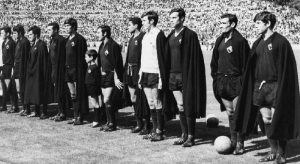
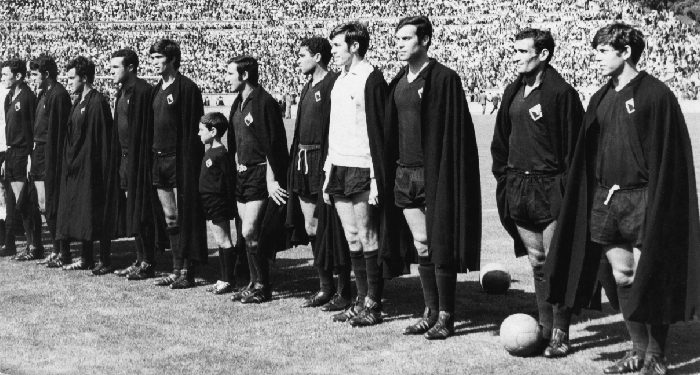
The Académica players entered the pitch wearing the traditional coats of the academic uniform, which is characteristic for the cityscape of Coimbra, and made clear whom they were solidary with. Already during the two semi-finals against Sporting Lisbon similar measures had been taken. In the first leg in the Estádio Alvalade the team entered the pitch with white shirts and black armbands, instead of the traditional black jerseys. But the players claimed to have chosen the white shirts due to the heat and not for political reasons, because “there is nobody going to the beach wearing black either”. In the second leg the move was unambiguous, when the club logo was taped, in order to draw the attention to the repression of the students.
Benfica player António Simões said about the atmosphere that day, that “he had already played in hundreds of packed grounds, but that he had never experienced such an atmosphere”. During the match the Coimbra fans unrolled their banners, on which could be read claims like “free university”, “Education for everybody” or “better classes, less police”. In order to not get caught by the civilian police the banners were rolled up and passed on, and reappeared at the other end of the stadium. As well the Benfica supporters joined in. Furthermore over 35.000 handouts were distributed to inform about the situation in the university city.
The match
The omens before the match were clear, Benfica with the great Eusébio was the favourite and Académica the clear outsider. The 60ies were the golden decade of the team from the capital, in which they celebrated eight league titles, three national cups, and two European Champion Clubs’ Cup wins. Besides the team of Académica, in contrast to the opponent, did not consist of professional players, but of students only, which was defined in its statutes. Among them also several students who originated from the colonies (Araújo, Chipenda, França), who were classified as dangerous elements by the police, and who were ascribed to the freedom movement of their countries. But still the team from the city at the Rio Mondego in those days was among the best four clubs of Portugal, and was unluckily eliminated in this year’s European cup edition by Olympique Lyon by coin toss, on which the face of Franco showed up.
In the final the students team held a 0:0 until the 80th minute, and were then even able to take the lead through Manuel António. After a free kick from the half field from Gervásio, António, surrounded by three rival players, let the ball bounce from his chest to the ground, and scored with a dropkick. But the sensation did not come true. Simões equalized two minutes before the final whistle from close range, after the keeper could not hold the ball from a free kick from 30 metres, which had passed through friend and enemy. In extra time it was the good playing Eusébio himself who decided the match. In the 109th minute he scored, with one of his rare headers the 2:1, after the ball was lobbed in from the edge of the penalty box. From that Coimbra did not recover anymore. After the final whistle there prevailed a friendly atmosphere and the players exchanged jerseys and did a lap of honour together. A few years ago, the at that time Académica defender José Belo, said in an interview, that in his opinion a win of Académica could have been dangerous and could have led to grave consequences.
Final of Taça de Portugal 2012
Just 43 years later, in 2012, Académica reached the final of Taça de Portugal again. But this time with the better end on their side, and after 73 years, through a 1:0 against Sporting Lisbon they could take home the cup again. The legend says that Coimbra did run out of beer this night. During the match the fans presented again critical banners, in the spirit of 1969. Thereby they particularly criticised the education policy, the expensive tuitions, and the high rate of youth unemployment. In comparison to 1969 this was just a little ray, but in an age, in which the UEFA applies censorship, and has banned every political message from the stadiums, it’s worth a note.